## min read

TMS vs Medication: Comparing Depression Treatments

|

September 23, 2026

Summarize with AI

TMS vs Medication: Comparing Depression Treatments

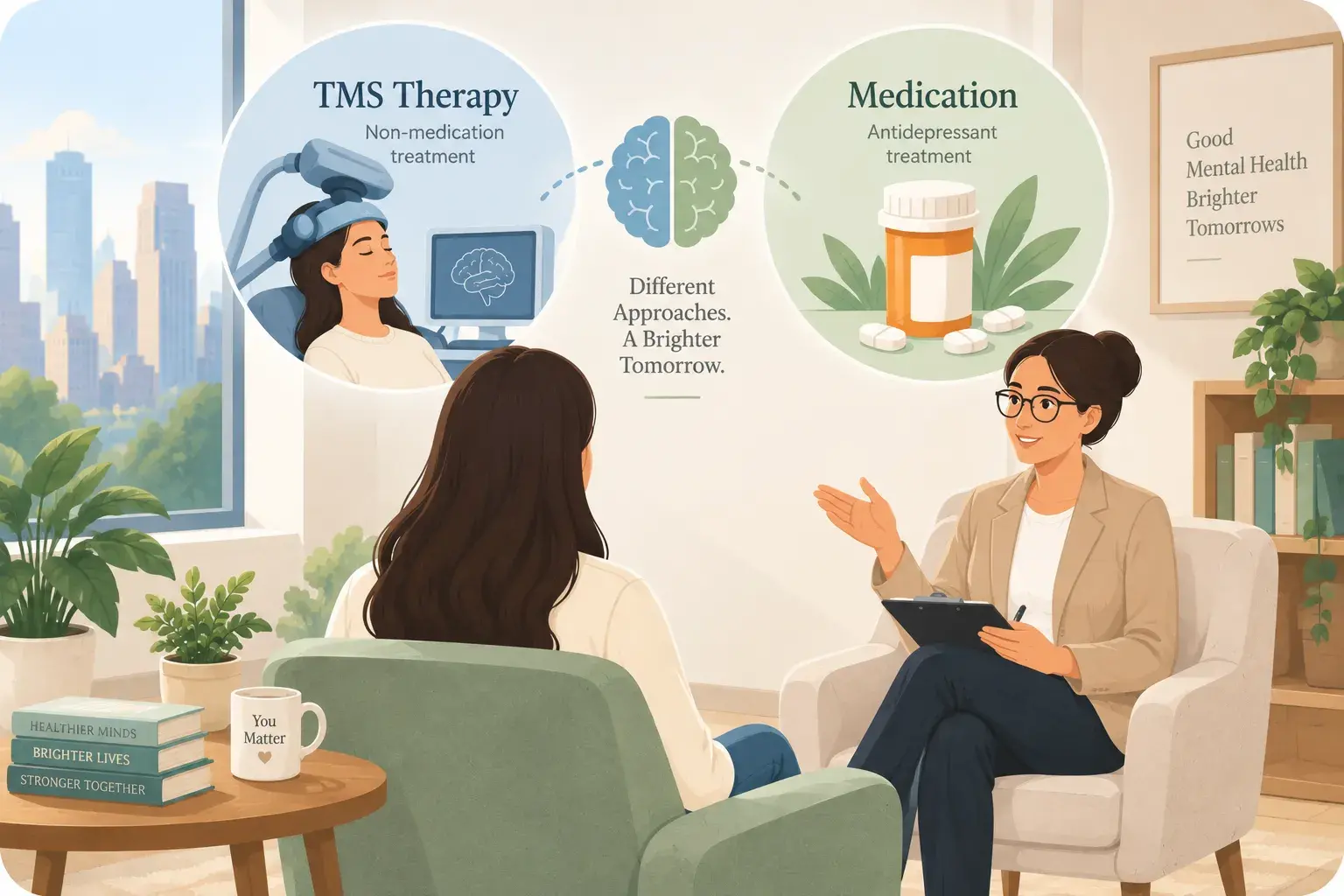
Most people comparing TMS vs medication for depression arrive at the question the same way: the antidepressants have not brought enough relief. If that is you, it helps to know that both are evidence-based, FDA-cleared treatments, and they work in completely different ways. Medication adjusts brain chemistry from the inside. TMS stimulates the brain directly with magnetic pulses. Neither is universally better. The right choice depends on your treatment history, the severity of your symptoms, how you tolerate side effects, and your own preferences, especially once you are dealing with treatment-resistant depression or trying to figure out what to do when antidepressants don't work. This article compares the two fairly, not to push one over the other.

How Antidepressants Work

Antidepressants change the availability of certain brain chemicals, mainly serotonin and norepinephrine, that influence mood. The most common are SSRIs (selective serotonin reuptake inhibitors) and SNRIs (serotonin-norepinephrine reuptake inhibitors). Both are considered first-line treatment, meaning they are usually where a clinician starts.

They are taken daily as a pill at home, and they work gradually. Most people need several weeks before the full effect shows, which is one of the harder parts of starting an antidepressant: you often have to wait to know whether it is working. Finding the right medication and dose regularly takes some trial and adjustment, and a first medication that does not help does not mean none will. There are many options within each class, so a clinician can switch or fine-tune based on how a person responds. Older tricyclic antidepressants (TCAs) also work but tend to cause harsher side effects, so they are usually reserved for later steps rather than first-line use. The main appeal of medication is convenience and evidence: it is taken at home, it is inexpensive, and it has decades of research behind it.

How TMS Works

Transcranial magnetic stimulation (TMS) is a non-invasive treatment that uses focused magnetic pulses, similar in strength to an MRI, to stimulate the mood-regulating areas of the brain that tend to be underactive in depression, mainly the left dorsolateral prefrontal cortex. It is FDA-cleared for major depressive disorder in adults, and also for OCD (NIMH, Brain Stimulation Therapies).

TMS is not electroconvulsive therapy (ECT). There is no anesthesia and no sedation, and the patient stays fully awake through each session, then drives home and returns to normal activity. During a session, a coil rests against the scalp and delivers pulses in short cycles, which most people feel as a tapping sensation. A typical course runs about five days a week for several weeks, with each session lasting under an hour, and the benefit tends to build gradually across the course rather than after any single visit.

As a non-drug option, TMS is one of the main alternatives to antidepressants for people whose medication has stopped short. It usually works best as part of a broader treatment plan, coordinated with therapy and, in many cases, ongoing medication, rather than as a replacement for all other care.

TMS vs Medication: Side-by-Side Comparison

The two treatments differ on almost every practical dimension, from how they are delivered to how quickly they work and what they ask of you day to day. The table below lays the key differences side by side, and the sections that follow unpack the two that matter most to people making this decision: side effects and success rates.

Factor Antidepressants TMS
How it works Adjusts brain chemistry (daily medication) Magnetic pulses stimulate mood-regulating brain areas
Schedule Daily pill, at home In-clinic sessions, about 5 days a week for several weeks
Onset Several weeks Often within a few weeks of the course
Common side effects Weight change, sexual dysfunction, fatigue, sleep changes Mild scalp discomfort or headache, usually fades after the first week
Effect on memory or cognition Varies by medication No known negative effect on memory or cognition
Best positioned for First-line, mild to moderate depression When medication has not worked or side effects are intolerable

Side Effects Compared

Antidepressant side effects vary by class. SSRIs commonly cause weight gain and sexual dysfunction, though some effects ease after the first few weeks. SNRIs have a similar profile that is often milder. TCAs tend to be harsher, which is why they are rarely a first choice. These are systemic effects, because the medication acts throughout the body.

TMS side effects are usually mild and short-lived: scalp discomfort, headache, or lightheadedness that typically passes soon after a session and lessens over the first week. The most serious risk, seizure, is very rare. Because TMS is non-invasive and targeted rather than systemic, it avoids the weight, sexual, and sleep side effects associated with medication, and it does not affect memory or cognition the way some people fear based on older brain treatments like ECT.

It is not side-effect-free, though, and its main practical downside is different in kind. Instead of a daily side effect, TMS asks for a time commitment: traveling to a clinic most weekdays for several weeks. For someone with a demanding schedule or limited transportation, that logistical cost is real and worth weighing against the appeal of avoiding medication side effects. Neither profile is automatically easier to live with; they are simply different, and which one fits depends on the person.

Success Rates: What the Research Shows

Both treatments help many people, and neither helps everyone. Reading the numbers honestly matters more than cheerleading for either one. Two terms come up often: response means a meaningful reduction in symptoms, usually cutting them roughly in half, while remission means symptoms largely resolve. Remission is the higher bar and the real goal.

For medication, the landmark STAR*D study found that roughly a third of patients reached remission on their first SSRI (Trivedi et al., American Journal of Psychiatry, 2006). That is a genuinely useful result for many people. But it also means most did not remit on the first try, and STAR*D showed that with each additional medication tried after a failure, the odds of remission tend to drop while side-effect burden tends to rise. That diminishing return is exactly the situation that leads people to look at other options.

For TMS, a large real-world registry of more than 5,000 patients found that most experienced measurable improvement, with response rates ranging from about 58% to 83% and remission from about 28% to 62%, depending on how outcomes were measured (Sackeim et al., Journal of Affective Disorders, 2020). The wide ranges are worth noting: they reflect different rating scales and patient groups, and many of those patients were also taking medication, so the numbers describe TMS in real-world use rather than in isolation.

For treatment-resistant depression specifically, a 2024 randomized trial compared TMS with switching or augmenting medication in 89 people who had not responded to at least two antidepressants, with both groups also receiving psychotherapy. The TMS group had significantly higher response and remission rates than the medication group (Dalhuisen et al., American Journal of Psychiatry, 2024). It is one of the clearest head-to-head comparisons available, though individual results always vary, and these figures describe groups, not guarantees for any one person.

When Antidepressants Don't Work: Where TMS Fits

About a third of people with major depressive disorder do not respond adequately to first-line treatment, a pattern clinicians call treatment-resistant depression. It is not a sign of personal failure or a rare edge case; it is common, and it has its own growing set of treatment options. When two or more medications have failed, or when side effects are intolerable, TMS becomes a well-supported next step, and the 2024 trial above is part of why it is increasingly positioned early in the treatment-resistant pathway rather than as a last resort.

TMS is not the only option at this stage. Spravato (esketamine), a nasal spray derived from ketamine, is FDA-approved for treatment-resistant depression when used together with an oral antidepressant. It is given in a certified clinic under medical supervision, with monitoring after each dose, because of its dissociative effects. Combining TMS with an antidepressant is another route, and research suggests the combination can improve outcomes over medication alone. The larger point is that once first-line medication falls short, the path forward branches into several evidence-based options, and those branches are not mutually exclusive. A person might use medication and TMS together, or move from one approach to another as their psychiatrist learns what their brain responds to.

Who Is Each Treatment For?

Medication is often the right starting point for someone who is:

  • Early in treatment for depression
  • Managing mild to moderate symptoms
  • Looking to avoid in-clinic visits
  • Someone who has responded well to an antidepressant before

TMS is generally considered for someone who:

  • Has tried multiple antidepressants without adequate relief
  • Cannot tolerate medication side effects
  • Prefers a non-drug approach
  • Has treatment-resistant depression

Many people use both at different points, and some use them together. Where a person lands is a clinical decision, not a solo consumer choice, and it belongs with a psychiatrist who knows the full history.

Making the Decision With a Psychiatrist

TMS, medication, Spravato, and therapy are not competing products. They are tools a psychiatrist combines and adjusts based on diagnosis, history, and how a person responds over time. Comparing TMS and medication on paper is useful, but the decision is rarely either-or, and it is rarely one-and-done. It usually looks more like a sequence: start somewhere reasonable, measure the response, and adjust. The most reliable way to navigate that sequence, and to change course when needed, is a thorough evaluation within an integrated care setting, where the clinician managing your medication is the same one weighing whether TMS or another option fits.

That is how care works at Amae Health. Our psychiatry-led teams evaluate the whole picture and coordinate treatment across medication, therapy, and procedures like TMS, which we offer at our Los Angeles clinic. You can explore our full range of treatments or, for severe depression that needs more structure, our Partial Hospitalization Program. Our resources for patients and families explain how integrated care works, and you can contact our team to ask about an evaluation.

Frequently Asked Questions

Is TMS better than medication for depression? Neither is universally better. Medication is first-line and works well for many people. For treatment-resistant depression, where two or more medications have failed, TMS often outperforms a medication switch. The right choice depends on history, severity, and side-effect tolerance.

Can you do TMS and take antidepressants at the same time? Yes. TMS can be combined with antidepressants, and research suggests the combination can improve outcomes compared with medication alone. This should be coordinated by a psychiatrist.

What are the side effects of TMS vs medication? TMS side effects are usually mild and short-lived, mainly scalp discomfort or headache that fades after the first week. Medication side effects vary but can include weight change, sexual dysfunction, and fatigue. Because it is non-invasive, TMS avoids the systemic side effects of medication.

Does TMS work when antidepressants don't? Often, yes. TMS is specifically supported for treatment-resistant depression. A 2024 randomized trial found higher response and remission rates with TMS than with switching medications after failed trials. Individual results vary.

How long does TMS treatment take? A typical course is sessions about five days a week for several weeks, each lasting under an hour. Antidepressants, by contrast, are taken daily and may take several weeks to show their full effect.

What if neither TMS nor medication works? Other options exist, including Spravato (esketamine) used with an oral antidepressant, combination approaches, and structured programs like IOP or PHP for severe depression. A psychiatrist can help identify next steps. Depression is hard, and support is available: if you are struggling, call or text the 988 Suicide and Crisis Lifeline at 988, anytime.

Citations

  1. Trivedi MH, Rush AJ, Wisniewski SR, et al. "Evaluation of Outcomes With Citalopram for Depression Using Measurement-Based Care in STAR*D." American Journal of Psychiatry, 2006. psychiatryonline.org. Tier 1 (peer-reviewed).
  2. Sackeim HA, Aaronson ST, Carpenter LL, et al. "Clinical outcomes in a large registry of patients with major depressive disorder treated with transcranial magnetic stimulation." Journal of Affective Disorders, 2020. sciencedirect.com. Tier 1 (peer-reviewed).
  3. Dalhuisen I, van Oostrom I, Spijker J, et al. "rTMS as a Next Step in Antidepressant Nonresponders: A Randomized Comparison With Current Antidepressant Treatment Approaches." American Journal of Psychiatry, 2024. PubMed 39108161. Tier 1 (peer-reviewed RCT).
  4. National Institute of Mental Health, "Brain Stimulation Therapies." nimh.nih.gov. Tier 2 (U.S. government).

Further reading (external resources): NIMH, Depression; Mayo Clinic, Transcranial Magnetic Stimulation.

Reccomended for you

# min read

What Does Severe Depression Feel Like and Look Like?

By

Sonia Garcia

|

February 12, 2026

Severe depression can feel like emotional numbness, crushing exhaustion, and hopelessness - and it can look like withdrawal, flat affect, and a person slowly losing the ability to function the way they used to.

For many people, the hardest part is the confusion. You may still show up, reply to messages, or get through the day on autopilot, while inside everything feels heavy, empty, or unreal. Others might only notice that you seem “off,” quieter, more irritable, or less present - even if you’re trying your best to hide it. In this article, we’ll break down what severe depression feels like and look like - including the emotional and physical feelings it creates and what evidence-based treatment options can actually help.

What is Severe Depression

Severe depression, clinically known as major depressive disorder (MDD), is a serious medical and emotional condition that goes far beyond feeling sad or having a bad day. It changes how a person thinks, feels, and functions in everyday life - often affecting sleep, appetite, energy, motivation, and relationships.

According to the National Institute of Mental Health, major depressive disorder is defined by a persistently depressed mood or loss of interest, combined with other symptoms that last most of the day, nearly every day, for at least two weeks and cause significant impairment in daily functioning.

What Does Severe Depression Look Like

Changes in Behavior

People with severe depression often start pulling away from normal life. Activities that once felt simple, like texting a friend, showering, and leaving the house, can begin to feel exhausting or pointless. This is not avoidance; it is the nervous system under strain.

What people notice How it often shows up
Social withdrawal Cancelling plans, ignoring messages, avoiding people
Flat or distant affect Less facial expression, monotone voice, low emotional response
Reduced engagement Not participating in conversations or activities
Irritability Snapping at others, frustration over small things
Disappearance from routines Not showing up to events, work, or social plans

Social withdrawal can deepen depression, which is why understanding the negative effects of social isolation matters.

Changes in Mood and Personality

Depression does not only affect how someone feels - it changes how they relate to themselves and others. Loved ones often say the person feels emotionally distant, flat, or “not like themselves anymore.”

Common emotional changes include:

  • Persistent hopelessness or pessimism
  • Emotional numbness or emptiness
  • Increased irritability or anger
  • Loss of emotional warmth or connection

Someone with severe depression may still laugh or smile occasionally, but underneath, their emotional world feels muted, heavy, or hollow. 

Changes in Daily Functioning

Severe depression doesn’t just affect mood - it begins to interfere with basic daily tasks and responsibilities. Even when someone wants to function normally, severe depression can disrupt the brain systems responsible for motivation, focus, and decision-making. As a result, basic tasks stop feeling automatic and begin to require intense mental and physical effort.

Common changes include:

  • Inability to initiate tasks, even when they matter
  • Extreme mental effort to complete simple actions
  • Difficulty concentrating or making decisions
  • Feeling “frozen” when trying to start or finish something

What Does Severe Depression Feel Like Physically

Fatigue and Low Energy

Individuals with severe depression often feel exhausted even after sleeping for many hours. The body feels heavy, slow, and drained, as if it is running on empty. Simple actions like standing up, showering, or walking outside can feel physically demanding.

This happens because depression disrupts the brain systems that regulate energy, motivation, and stress. As a result, the nervous system stays in a depleted state, making rest feel unrefreshing and movement feel difficult.

Sleep and Appetite Changes

Severe depression often throws off the body’s natural rhythms. Some people struggle with insomnia and lie awake feeling restless or wired, while others sleep excessively but still wake up exhausted. Appetite may also change - food can lose its appeal, or eating may become a way to cope with emotional emptiness.

These shifts create a cycle:

  • Poor sleep increases fatigue
  • Fatigue reduces motivation
  • Low motivation worsens mood
  • Worsening mood further disrupts sleep and eating

Pain, Aches, and Brain Fog

Many people with severe depression experience real physical discomfort. Headaches, muscle tension, back pain, and unexplained aches are common. At the same time, thinking can feel slow and foggy - like trying to focus through a thick mental haze.

This happens because depression affects how the brain processes pain, attention, and memory. The result is not just emotional suffering, but a full-body experience that makes even thinking clearly feel difficult.

When Severe Depression Becomes a Clinical Condition

Severe depression becomes a clinical condition when it is persistent, intense, and begins to interfere with daily life. Instead of coming and going with circumstances, the low mood, numbness, or hopelessness stay present for weeks or months. People may find it hard to work, connect with others, or take care of themselves, even when they want to.

At this point, depression is no longer just a reaction to stress or loss - it is a disorder of the brain and nervous system. That is what clinicians call major depressive disorder, and it requires professional treatment, not willpower.

Treatment Options for Severe Depression

Therapy and Psychological Support

Therapy helps people with severe depression understand what is happening in their mind and learn how to change the patterns that keep them stuck. Evidence-based approaches like cognitive behavioral therapy (CBT) and trauma-informed therapy focus on how thoughts, emotions, and behaviors interact.

In therapy, people learn how to:

  • Recognize distorted or self-critical thinking
  • Regulate overwhelming emotions
  • Rebuild motivation and connection
  • Develop healthier coping strategies

Medication for Severe Depression

When depression is severe, medication can play a critical role in stabilizing mood and restoring basic functioning. Antidepressants work by helping balance the brain chemicals involved in mood, sleep, and energy. When those systems are disrupted, people may feel constantly drained, emotionally numb, or overwhelmed.

Medication does not change who someone is - it helps reduce the intensity of symptoms so the person can think more clearly, engage in therapy, and begin rebuilding daily life. For many people with severe depression, medication creates the foundation that makes other forms of treatment possible. If you want a clearer explanation of how these meds work in the brain, see our article: How do mood stabilizers work?

Structured and Intensive Care

Some people need more support than weekly therapy can provide. Structured care offers a higher level of monitoring, treatment, and stability.

Level of care What it provides Best for
Outpatient Weekly therapy and medication management Mild to moderate symptoms
IOP (Intensive Outpatient Program) Several therapy sessions per week while living at home Moderate to severe depression
Inpatient 24/7 medical and psychiatric care Severe symptoms or safety concerns

This stepped approach allows treatment to match the intensity of the illness.

How Amae Health Helps People With Severe Depression

Amae Health is a specialized mental health clinic designed for people struggling with serious and persistent mental health conditions, including severe depression. Our treatment offerings go beyond surface-level symptom management - we focus on understanding the whole person and building a treatment plan that fits their unique needs.

We provide psychiatric evaluation, therapy, medication management, and structured services for people who need more than occasional support. Whether someone is newly experiencing severe symptoms or has been struggling for a long time, our team works to create stability, safety, and a path forward.

You can reach Amae Health directly or refer a loved one by contacting our clinic to begin a confidential assessment and explore the right level of care.

# min read

Major Depressive Disorder vs Persistent Depressive Disorder Compared

By

Sonia Garcia

|

May 6, 2026

Two people walk into the same psychiatrist's office with the same sentence: "I think I'm depressed." The first has been hit, in the last few weeks, by something that feels like a door closing. Sleep is wrong, food is wrong, work has become impossible, and the idea of the next year feels heavier than she can carry. The second has felt something different for as long as she can remember. Not a door closing, but a dim room she has always lived in. Lower energy, lower mood, lower hope, all at a level just functional enough that she learned to call it her personality. The difference between what each of them is experiencing is, in clinical terms, major depressive disorder vs persistent depressive disorder.

Both women are clinically depressed, but they may not be experiencing the same condition. MDD and PDD share symptoms but differ in severity, duration, and the treatment approach that actually works.

What Is Major Depressive Disorder (MDD)?

Major depressive disorder, often called clinical depression or a major depressive episode, is defined by an acute, intense period of depression lasting at least two weeks. Functioning is usually significantly impaired. Work, relationships, basic self-care, and the ability to find pleasure in anything can all grind to a halt.

A diagnosis of MDD requires five or more of the following symptoms during the same two-week period:

  • Depressed mood most of the day, nearly every day
  • Loss of interest or pleasure in nearly all activities
  • Significant changes in sleep or appetite
  • Fatigue or loss of energy
  • Feelings of worthlessness or excessive guilt
  • Difficulty concentrating or making decisions
  • Thoughts of death or suicide

MDD is episodic. Episodes start, they end, and people generally return to a stable baseline between them. Roughly half of patients who experience one episode will experience another, and the risk increases sharply with each subsequent episode (Burcusa & Iacono, Clinical Psychology Review, 2007).

What Is Persistent Depressive Disorder (PDD)?

Persistent depressive disorder, also known as dysthymia, is the chronic form of depression. The diagnosis requires a depressed mood most of the day, more days than not, for at least two years in adults (one year in children and adolescents). The intensity is usually lower than a major depressive episode, but the duration is longer, and the functional cost adds up.

Common hallmark traits include:

  • Long-term low mood that rarely lifts fully
  • Persistent low energy
  • Low self-esteem
  • Reduced motivation
  • Trouble concentrating or making decisions
  • A sense of hopelessness that has become background

Many people with PDD describe their mood as "just how I am." That is part of what makes the condition easy to miss. A person who has felt this way since high school does not usually show up asking for treatment for depression. They shows up asking about sleep, or work, or a relationship that keeps falling apart.

Major Depressive Disorder vs Persistent Depressive Disorder: Key Differences

At a glance:

Diagnosis Symptom Intensity Duration Functional Impact
Major Depressive Disorder (MDD) Severe At least 2 weeks per episode Often incapacitating during an episode
Persistent Depressive Disorder (PDD) Lower-grade At least 2 years, continuous Steady and cumulative, often chronic

The two conditions are not mutually exclusive. A person with PDD can have a full major depressive episode on top of her chronic baseline. Clinicians sometimes call this double depression. On a day-to-day level, it looks like someone whose mood has been low for a decade suddenly experiences a period where getting out of bed is not just hard, but actually impossible.

Double depression tends to be more difficult to treat and has a higher risk of relapse than either MDD or PDD alone. Recognizing the chronic baseline underneath the acute episode is what changes the treatment plan.

Causes and Risk Factors of MDD and PDD

MDD and PDD share most of their underlying risk factors. Both are shaped by a mix of biological vulnerability, psychological patterns, and environmental stressors. No single cause explains either condition, and the interaction between genes and environment matters more than either alone.

Shared Risk Factors

Research consistently points to a handful of contributors:

  • Family history of mood disorders, which raises risk for both conditions
  • Trauma, especially in childhood, which is strongly linked to chronic depression in particular
  • Chronic stress at work, in caregiving, or in financial or social conditions
  • Substance use, which can precipitate, deepen, or mimic depression
  • Medical conditions like hypothyroidism, chronic pain, and other systemic illnesses

How Are MDD and PDD Diagnosed?

There is no blood test for either condition. Diagnosis is clinical, made by a psychiatrist, psychologist, or trained primary care clinician based on a structured interview, symptom history, and functional assessment. Medical causes such as thyroid disease, anemia, or medication side effects are ruled out first because they can mimic depressive symptoms.

The evaluation looks at the pattern of symptoms over time, not only how a person feels today. A current snapshot cannot distinguish MDD from PDD. But a careful history can.

How the DSM-5 Classifies MDD and PDD

The DSM-5 uses three main dimensions to tell the conditions apart: symptom count, duration, and functional impairment.

MDD requires at least five of nine specific symptoms during a two-week period, with significant impairment. PDD requires fewer symptoms (at least two alongside depressed mood) but for a much longer time: at least two continuous years, with no more than two symptom-free months at a stretch. Accurate classification matters because the treatment path, expected duration of care, and relapse-prevention plan all look different.

Persistent Depressive Disorder vs Major Depressive Disorder Treatment Differences

Both MDD and PDD respond to the same general toolkit: psychotherapy, medication, and in some cases advanced interventions. The way that toolkit is applied differs.

For MDD, the goal is to resolve the episode and prevent the next one. Antidepressant medication (commonly SSRIs or SNRIs) is frequently started early in an episode. Evidence-based therapies like cognitive behavioral therapy (CBT) and interpersonal therapy are effective on their own and work better in combination with medication for moderate-to-severe presentations (Cuijpers et al., World Psychiatry, 2014). For patients who do not respond to two or more antidepressant trials, advanced options like TMS or Spravato (esketamine, FDA-approved for treatment-resistant depression in 2019) can help (FDA News Release, March 2019).

For PDD, treatment runs longer because the condition itself runs longer. Medication alone often falls short for chronic depression. A specialized psychotherapy called CBASP (Cognitive Behavioral Analysis System of Psychotherapy), developed specifically for chronic depression, is one of the few therapies explicitly targeted to PDD. A landmark trial found a combination of CBASP with an antidepressant produced an 85% response rate in patients who completed treatment (Keller et al., New England Journal of Medicine, 2000). Relapse prevention is a bigger part of the plan for PDD because the baseline is chronic.

When to Seek Professional Help

If you have had symptoms of depression for weeks that will not lift, if you have felt "low" for years and simply gotten used to it, or if your functioning at work, school, or in relationships has shifted in a way that worries you or the people close to you, it is time for a clinical evaluation. For immediate safety concerns, call 988 for the Suicide and Crisis Lifeline.

For deeper reading on the experience of MDD itself, see our guide to what severe depression feels like.

MDD and PDD Treatment at Amae Health

At Amae Health, accurate diagnosis is the first step. The treatment plan for MDD looks different from the plan for PDD, and the plan for double depression looks different from either. A comprehensive psychiatric evaluation at intake sorts out which picture fits, what the medical workup needs to rule out, and what the next 6 to 12 months should look like.

From there, our integrated care model coordinates therapy, medication management, primary care, and advanced options when appropriate. A typical path:

  1. Schedule an assessment with our intake team
  2. Receive a personalized care plan built around your specific diagnosis and goals
  3. Begin structured, evidence-based treatment with a coordinated clinical team

If depression has been running your life for weeks or for years, you do not have to figure it out alone. Call 1-888-860-2825 or request an intake appointment to start.

Citations

  1. Burcusa & Iacono, "Risk for Recurrence in Depression," Clinical Psychology Review, 2007. Tier 1 (peer-reviewed).
  2. Cuijpers et al., "Adding Psychotherapy to Antidepressant Medication in Depression and Anxiety Disorders: A Meta-Analysis," World Psychiatry, 2014. Tier 1 (peer-reviewed).
  3. FDA News Release, "FDA Approves New Nasal Spray Medication for Treatment-Resistant Depression," March 2019. Tier 2 (government).
  4. Keller et al., "A Comparison of Nefazodone, the Cognitive Behavioral-Analysis System of Psychotherapy, and Their Combination for the Treatment of Chronic Depression," New England Journal of Medicine, 2000. Tier 1 (peer-reviewed).

# min read

Bipolar Disorder Supportive Therapy: How It Helps Stabilize Mood

By

Sonia Garcia

|

May 18, 2026

Bipolar disorder changes the weather inside a life. Mood swings disrupt work, sleep, relationships, and the sense that next month will look anything like this one. The emotional exhaustion of cycling through episodes and the strain those episodes put on close relationships are part of why so many patients describe bipolar disorder as harder to live with than almost any other condition they know. Medication is usually the foundation of treatment. But medication alone is rarely enough. Bipolar disorder supportive therapy is one of several psychotherapy approaches that sit alongside medication to turn stability into an actual life.

This guide explains what supportive therapy is, how it fits alongside other therapies, and what kind of help may improve day-to-day stability.

What Is Supportive Therapy For Bipolar Disorder?

Supportive therapy is a psychotherapy approach built around emotional support, trust, validation, and practical coping. It does not focus on deep analysis of the unconscious, and it is not a structured skills protocol. It is the kind of therapy where a clinician listens carefully, helps you make sense of what you are feeling and going through, reinforces what is working, and helps you solve the next problem in front of you.

Supportive therapy is almost always part of a broader treatment plan for bipolar disorder, not a replacement for psychiatric care. Most people combine it with medication management, and many eventually layer in more structured approaches like CBT or family-focused therapy.

What Techniques Are Used in Bipolar Disorder Supportive Therapy

The practical tools a supportive therapist uses include:

  • Emotional validation that acknowledges the real weight of what the person is experiencing
  • Active listening that slows down and surfaces what is actually going on, not just the surface complaint
  • Psychoeducation about the illness cycle, warning signs, and what to expect
  • Problem-solving on concrete day-to-day stressors, from a difficult conversation to a medication side effect
  • Strengthening insight about mood patterns and personal triggers
  • Reinforcing engagement in the full treatment plan, including appointments and medication

How Supportive Therapy Helps People With Bipolar Disorder

Emotional Support During Mood Instability

Mood episodes are disorienting. A depressive stretch can last weeks, a hypomanic period can feel like the most productive month of your life until it crashes, and a mixed episode can fold both into the same week. Supportive therapy gives a person somewhere to bring that weight, week after week, with someone who understands what bipolar disorder looks like from the inside. That consistency alone steadies many patients through the worst stretches.

Building Coping Skills And Daily Stability

The practical work of staying well with bipolar disorder is mostly about routines. Supportive therapy helps people build and protect them:

  • Consistent sleep and wake times, because sleep disruption is a common trigger
  • Strategies for stress management when life gets loud
  • Conflict management skills for relationships under strain
  • Recognizing early warning signs of an episode so they can be interrupted

Supporting Medication Adherence And Ongoing Care

Medication is the foundation of bipolar treatment. But it can also be hard to stay on. Side effects, the feeling of missing hypomanic energy, the belief that symptoms will not return, and plain forgetfulness all contribute to the high discontinuation rates that research keeps finding. Supportive therapy gives people a place to talk honestly about their fears and frustrations with medication, think through side effects with a trusted clinician, and stay engaged when the usual instinct would be to drop out.

Supportive Therapy vs. Other Therapy Approaches

Supportive therapy is one of several psychotherapy approaches with evidence for bipolar disorder. A quick comparison:

Therapy Primary focus Typical use in bipolar disorder
Supportive therapy Emotional support, coping, engagement Early in treatment, during stabilization, alongside medication
Cognitive behavioral therapy (CBT) Identifying and reshaping unhelpful thought patterns Managing depressive episodes, relapse prevention
Dialectical behavior therapy (DBT) Emotion regulation, distress tolerance, interpersonal skills High emotional reactivity, self-harm risk, co-occurring BPD
Family-focused therapy (FFT) Communication and relapse planning with family Adolescents and adults with close family involvement
Interpersonal and social rhythm therapy (IPSRT) Stabilizing sleep, routines, and interpersonal patterns Rhythm disruption, relationship stressors, mood cycling

A large systematic review of 39 randomized trials of adjunctive psychotherapy for bipolar disorder found that family-focused, cognitive behavioral, and psychoeducational therapies reduced episode recurrence compared with usual treatment (Miklowitz et al., JAMA Psychiatry, 2021).

When Other Therapies May Be Added

Supportive therapy is often the right starting point, especially after a new diagnosis or during stabilization. Over time, many patients add a more structured approach:

  • CBT for persistent depressive symptoms or to build relapse-prevention skills
  • DBT for patients with heavy emotional reactivity or co-occurring BPD features
  • IPSRT for people whose episodes are tied to disrupted sleep and routines
  • Family-focused therapy when relationship dynamics are shaping the illness course

The choice depends on symptoms, goals, and what the person actually needs at that stage. A skilled clinician will adjust the approach as the picture changes.

What To Expect In Bipolar Disorder Supportive Therapy

Sessions are usually 45 to 50 minutes and are typically weekly at the start. The work is conversational rather than homework-driven. A session might open with what happened that week, look at mood patterns since the last visit, surface any new stressors, and end with a small plan for the week ahead.

The clinician will pay attention to warning signs: sleep changes, energy shifts, spending or relationship patterns, and medication side effects. Over time, a person in supportive therapy often becomes much better at tracking their own mood, which makes the intervals between episodes longer and the episodes themselves shorter.

Who May Benefit Most

Supportive therapy tends to help most for:

  • People newly diagnosed who need to make sense of what bipolar disorder is and what the next year can look like
  • People adjusting to treatment who are figuring out medication, routines, and how to communicate about the illness
  • People navigating the emotional fallout of a recent episode, including shame, regret, or strain with family
  • People in long-term stabilization who want a steady clinician presence without intensive protocols

It is less of a match for patients who need heavy skills training for severe emotion dysregulation or those in active crisis, where higher levels of care are indicated.

When To Seek Professional Help For Bipolar Disorder

A few questions to ask yourself:

  • Are mood episodes interfering with work, school, or close relationships?
  • Has your sleep pattern changed significantly for more than a week?
  • Are you making impulsive decisions that later feel hard to explain?
  • Is someone close to you saying your behavior feels out of character?
  • Are you having thoughts of self-harm or suicide?

If the answer to any of these is yes, it is worth calling a clinician. For immediate safety concerns, call 988 for the Suicide and Crisis Lifeline.

Bipolar Disorder Care At Amae Health

At Amae Health, we support individuals battling bipolar disorder. Our approach is integrated: psychiatrists, therapists, primary care providers, dietitians, health coaches, peer mentors, and clinical care coordinators all work from one shared treatment plan. That structure matters for bipolar disorder, because the condition touches sleep, physical health, medication, and relationships at the same time, and fragmented care usually misses something.

If bipolar symptoms are disrupting daily life for you or someone you love, we can help with evaluation, treatment planning, and ongoing support. Learn more about our bipolar disorder care, read our guide to the most effective treatments for bipolar disorder, or call 1-888-860-2825 to start the conversation.

Citations

  1. Miklowitz et al., "Adjunctive Psychotherapy for Bipolar Disorder: A Systematic Review and Component Network Meta-analysis," JAMA Psychiatry, 2021. Tier 1 (peer-reviewed).