
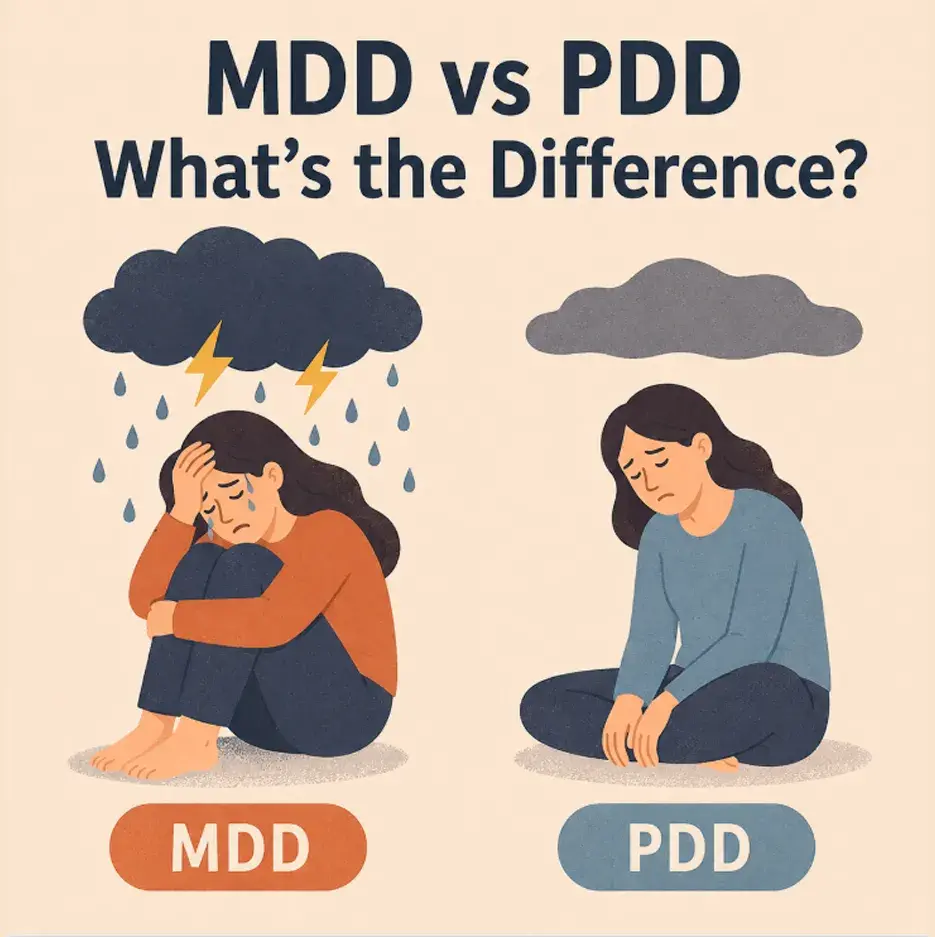
Two people walk into the same psychiatrist's office with the same sentence: "I think I'm depressed." The first has been hit, in the last few weeks, by something that feels like a door closing. Sleep is wrong, food is wrong, work has become impossible, and the idea of the next year feels heavier than she can carry. The second has felt something different for as long as she can remember. Not a door closing, but a dim room she has always lived in. Lower energy, lower mood, lower hope, all at a level just functional enough that she learned to call it her personality. The difference between what each of them is experiencing is, in clinical terms, major depressive disorder vs persistent depressive disorder.
Both women are clinically depressed, but they may not be experiencing the same condition. MDD and PDD share symptoms but differ in severity, duration, and the treatment approach that actually works.
What Is Major Depressive Disorder (MDD)?
Major depressive disorder, often called clinical depression or a major depressive episode, is defined by an acute, intense period of depression lasting at least two weeks. Functioning is usually significantly impaired. Work, relationships, basic self-care, and the ability to find pleasure in anything can all grind to a halt.
A diagnosis of MDD requires five or more of the following symptoms during the same two-week period:
- Depressed mood most of the day, nearly every day
- Loss of interest or pleasure in nearly all activities
- Significant changes in sleep or appetite
- Fatigue or loss of energy
- Feelings of worthlessness or excessive guilt
- Difficulty concentrating or making decisions
- Thoughts of death or suicide
MDD is episodic. Episodes start, they end, and people generally return to a stable baseline between them. Roughly half of patients who experience one episode will experience another, and the risk increases sharply with each subsequent episode (Burcusa & Iacono, Clinical Psychology Review, 2007).
What Is Persistent Depressive Disorder (PDD)?
Persistent depressive disorder, also known as dysthymia, is the chronic form of depression. The diagnosis requires a depressed mood most of the day, more days than not, for at least two years in adults (one year in children and adolescents). The intensity is usually lower than a major depressive episode, but the duration is longer, and the functional cost adds up.
Common hallmark traits include:
- Long-term low mood that rarely lifts fully
- Persistent low energy
- Low self-esteem
- Reduced motivation
- Trouble concentrating or making decisions
- A sense of hopelessness that has become background
Many people with PDD describe their mood as "just how I am." That is part of what makes the condition easy to miss. A person who has felt this way since high school does not usually show up asking for treatment for depression. They shows up asking about sleep, or work, or a relationship that keeps falling apart.
Major Depressive Disorder vs Persistent Depressive Disorder: Key Differences
At a glance:
The two conditions are not mutually exclusive. A person with PDD can have a full major depressive episode on top of her chronic baseline. Clinicians sometimes call this double depression. On a day-to-day level, it looks like someone whose mood has been low for a decade suddenly experiences a period where getting out of bed is not just hard, but actually impossible.
Double depression tends to be more difficult to treat and has a higher risk of relapse than either MDD or PDD alone. Recognizing the chronic baseline underneath the acute episode is what changes the treatment plan.
Causes and Risk Factors of MDD and PDD
MDD and PDD share most of their underlying risk factors. Both are shaped by a mix of biological vulnerability, psychological patterns, and environmental stressors. No single cause explains either condition, and the interaction between genes and environment matters more than either alone.
Shared Risk Factors
Research consistently points to a handful of contributors:
- Family history of mood disorders, which raises risk for both conditions
- Trauma, especially in childhood, which is strongly linked to chronic depression in particular
- Chronic stress at work, in caregiving, or in financial or social conditions
- Substance use, which can precipitate, deepen, or mimic depression
- Medical conditions like hypothyroidism, chronic pain, and other systemic illnesses
How Are MDD and PDD Diagnosed?
There is no blood test for either condition. Diagnosis is clinical, made by a psychiatrist, psychologist, or trained primary care clinician based on a structured interview, symptom history, and functional assessment. Medical causes such as thyroid disease, anemia, or medication side effects are ruled out first because they can mimic depressive symptoms.
The evaluation looks at the pattern of symptoms over time, not only how a person feels today. A current snapshot cannot distinguish MDD from PDD. But a careful history can.
How the DSM-5 Classifies MDD and PDD
The DSM-5 uses three main dimensions to tell the conditions apart: symptom count, duration, and functional impairment.
MDD requires at least five of nine specific symptoms during a two-week period, with significant impairment. PDD requires fewer symptoms (at least two alongside depressed mood) but for a much longer time: at least two continuous years, with no more than two symptom-free months at a stretch. Accurate classification matters because the treatment path, expected duration of care, and relapse-prevention plan all look different.
Persistent Depressive Disorder vs Major Depressive Disorder Treatment Differences
Both MDD and PDD respond to the same general toolkit: psychotherapy, medication, and in some cases advanced interventions. The way that toolkit is applied differs.
For MDD, the goal is to resolve the episode and prevent the next one. Antidepressant medication (commonly SSRIs or SNRIs) is frequently started early in an episode. Evidence-based therapies like cognitive behavioral therapy (CBT) and interpersonal therapy are effective on their own and work better in combination with medication for moderate-to-severe presentations (Cuijpers et al., World Psychiatry, 2014). For patients who do not respond to two or more antidepressant trials, advanced options like TMS or Spravato (esketamine, FDA-approved for treatment-resistant depression in 2019) can help (FDA News Release, March 2019).
For PDD, treatment runs longer because the condition itself runs longer. Medication alone often falls short for chronic depression. A specialized psychotherapy called CBASP (Cognitive Behavioral Analysis System of Psychotherapy), developed specifically for chronic depression, is one of the few therapies explicitly targeted to PDD. A landmark trial found a combination of CBASP with an antidepressant produced an 85% response rate in patients who completed treatment (Keller et al., New England Journal of Medicine, 2000). Relapse prevention is a bigger part of the plan for PDD because the baseline is chronic.
When to Seek Professional Help
If you have had symptoms of depression for weeks that will not lift, if you have felt "low" for years and simply gotten used to it, or if your functioning at work, school, or in relationships has shifted in a way that worries you or the people close to you, it is time for a clinical evaluation. For immediate safety concerns, call 988 for the Suicide and Crisis Lifeline.
For deeper reading on the experience of MDD itself, see our guide to what severe depression feels like.
MDD and PDD Treatment at Amae Health
At Amae Health, accurate diagnosis is the first step. The treatment plan for MDD looks different from the plan for PDD, and the plan for double depression looks different from either. A comprehensive psychiatric evaluation at intake sorts out which picture fits, what the medical workup needs to rule out, and what the next 6 to 12 months should look like.
From there, our integrated care model coordinates therapy, medication management, primary care, and advanced options when appropriate. A typical path:
- Schedule an assessment with our intake team
- Receive a personalized care plan built around your specific diagnosis and goals
- Begin structured, evidence-based treatment with a coordinated clinical team
If depression has been running your life for weeks or for years, you do not have to figure it out alone. Call 1-888-860-2825 or request an intake appointment to start.
Citations
- Burcusa & Iacono, "Risk for Recurrence in Depression," Clinical Psychology Review, 2007. Tier 1 (peer-reviewed).
- Cuijpers et al., "Adding Psychotherapy to Antidepressant Medication in Depression and Anxiety Disorders: A Meta-Analysis," World Psychiatry, 2014. Tier 1 (peer-reviewed).
- FDA News Release, "FDA Approves New Nasal Spray Medication for Treatment-Resistant Depression," March 2019. Tier 2 (government).
- Keller et al., "A Comparison of Nefazodone, the Cognitive Behavioral-Analysis System of Psychotherapy, and Their Combination for the Treatment of Chronic Depression," New England Journal of Medicine, 2000. Tier 1 (peer-reviewed).