
In a study that followed people with bipolar I disorder for an average of 12.8 years, depressive symptoms were present in about 32% of weeks, compared with 9% for manic or hypomanic symptoms. In bipolar I disorder, depression is the part people live with most, which is why so many ask: does TMS work for bipolar depression?
The research is encouraging. A 2025 meta-analysis of 56 studies and 1,709 patients found response and remission rates on par with those for TMS in major depression. But TMS is not FDA-cleared for bipolar depression. It holds a breakthrough device designation, which is a different thing, and using it for bipolar depression is off-label.
How TMS Works for Bipolar Depression
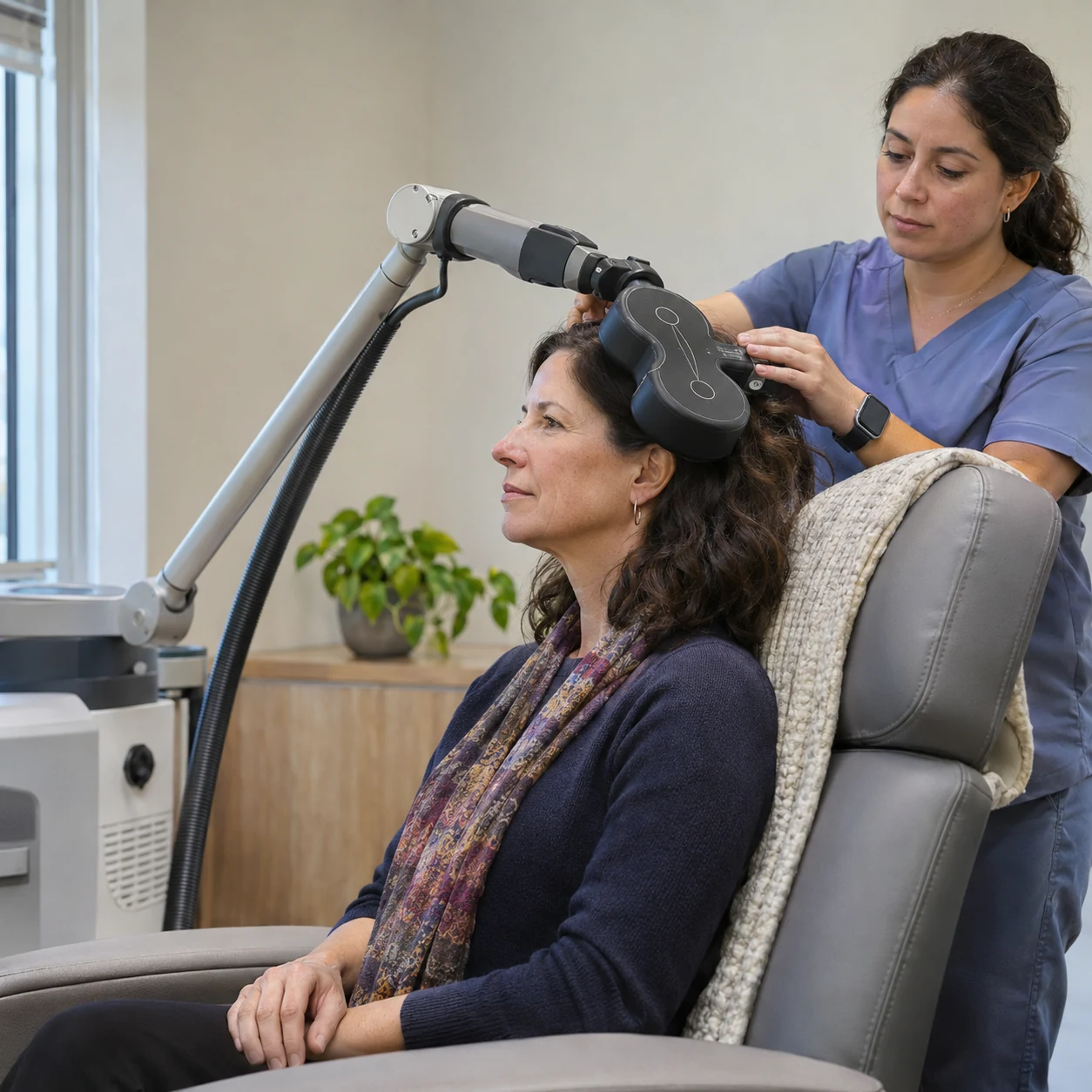
The device and the basic method are the same ones used for major depression. A coil held against the scalp sends focused magnetic pulses into the prefrontal cortex, a brain region involved in regulating mood. No anesthesia is needed, and you stay awake throughout.
Side effects are usually mild. NIMH lists discomfort at the stimulation site, tingling or contraction of scalp, jaw, or face muscles during the pulses, mild headaches, and brief lightheadedness or dizziness. The rare serious risk is a seizure, which is why screening asks about seizure history before treatment starts.
What's different is what it's being used for. TMS for bipolar disorder treats one phase of the illness, the depressive episode, not the illness as a whole. It doesn't prevent future manic or depressive episodes. That remains the work of mood stabilization and ongoing care.
Protocols vary across the research. In the 2025 meta-analysis, the most common approach was high-frequency stimulation over the left dorsolateral prefrontal cortex, used in 24 studies. Low-frequency stimulation on the right side came next, in 10 studies, followed by a faster pattern called intermittent theta burst stimulation, in eight. The two most-studied approaches were each significantly associated with antidepressant effects. Left-sided theta burst stimulation and a right-then-left sequence also showed significant effects, with fewer studies behind them.
Is TMS FDA-Approved for Bipolar Depression?
No. The National Institute of Mental Health's overview of brain stimulation therapies lists rTMS as FDA-cleared for treatment-resistant depression, OCD, migraines, anxiety with depression, and smoking dependence. Bipolar depression is not on that list.
In 2020, the FDA granted rTMS a breakthrough device designation for bipolar depression. NIMH describes that designation as one given to devices with preliminary evidence of clinical effectiveness compared with available treatments. The FDA says its Breakthrough Devices Program is meant to speed up development and review of certain devices; designation is not authorization to market.
It isn't clearance.
Until a device is cleared for bipolar depression, using TMS for it is off-label. A psychiatrist can offer it based on clinical judgment, but that use hasn't been through the FDA review that the major depression indication has.
What the Research Shows About TMS for Bipolar Depression
The most comprehensive evidence comes from the 2025 systematic review and meta-analysis in Biological Psychiatry: Global Open Science. It pooled 56 studies covering 1,709 people with bipolar depression: 31 randomized controlled trials, 17 open-label trials, and eight retrospective studies.
Across all of those studies, about 47% of people responded to TMS and about 28% reached remission. The authors described those rates as on par with rates for unipolar depression, the standard use of TMS.
The sham-controlled trials carry the most weight, because they separate the treatment's effect from the effect of expectation. In those trials, active TMS roughly doubled the odds of both response and remission compared with sham stimulation. That works out to one additional responder for every eight people treated, and one additional remission for every nine.
The evidence has real limits. Many of the studies were small, protocols varied widely, and results were not broken out by bipolar I versus bipolar II. A 2026 meta-analysis limited to randomized trials found a smaller effect, with most individual trials not reaching significance on their own. Real-world data suggest the benefit carries over into everyday practice, though non-randomized estimates are more prone to bias, and reports conflict on whether TMS works better or worse in bipolar depression than in major depression. For a meaningful share of people, TMS does help bipolar depression. For any one person, it's a possibility to evaluate with a psychiatrist, not a promise.
Risk of Triggering Mania or Hypomania
Can TMS cause mania? For anyone with bipolar disorder, the risk of switching into mania or hypomania matters as much as whether a treatment works.
In the sham-controlled trials pooled in the 2025 meta-analysis, switches were uncommon in both groups: nine among people receiving active TMS and four among those receiving sham. The difference was not statistically significant (odds ratio 1.3, with a 95% confidence interval of 0.7 to 2.4).
Two caveats keep that reassurance in proportion. Small numbers of events make rare risks hard to rule out. And 45 of the 56 studies reported that participants were taking mood stabilizers alongside TMS, so the safety data mostly describe people who were already mood-stabilized. In practice, that means TMS for bipolar depression belongs alongside adequate mood stabilization, with a psychiatrist watching for early signs of a switch, such as a reduced need for sleep, racing thoughts, or unusual irritability.
If early signs appear, the psychiatrist can pause sessions and reassess medication before going further. That's one reason TMS for bipolar depression fits best inside ongoing psychiatric care, where the team already knows the person's patterns, rather than as a stand-alone service.
Who Might Be a Candidate
Candidacy is a clinical determination, not a checklist for self-assessment. The profile that fits the research generally includes:
- A current depressive episode in bipolar I or bipolar II disorder. TMS is used during depression, not during mania or hypomania.
- Mood stabilization in place, or being started, with a psychiatrist managing it. Our explainer on how mood stabilizers work covers why that foundation matters.
- Depression that hasn't improved enough with medication and therapy.
- No contraindications to TMS, such as a history of seizures, metal in the head, or implanted devices like pacemakers.
- The ability to attend sessions most weekdays for several weeks.
What TMS Does Not Replace
TMS can treat a depressive episode. It does not treat bipolar disorder as a whole.
Mood stabilizers, ongoing psychiatric care, psychotherapy, and steady daily routines remain central to long-term bipolar treatment. TMS doesn't replace any of them, and the need for them continues after the depression lifts. Other options for bipolar depression exist too, including a limited number of medications approved for it and, for severe episodes, electroconvulsive therapy (ECT), which NIMH notes is cleared for severe depressive episodes in bipolar disorder. When the depression lifts, attention turns back to preventing the next episode, through medication, regular follow-up, and a plan for spotting early warning signs. Our overview of effective bipolar disorder treatment covers the broader picture.
Talking to a Psychiatrist About TMS for Bipolar Depression
Whether TMS makes sense for a particular person's bipolar depression is a decision for a psychiatrist who knows the whole history: past manic and hypomanic episodes, how mood stabilizers have worked, what has been tried for depression, and what's safe to add.
At Amae, we specialize in bipolar disorder treatment through a single care team that includes psychiatrists, therapists, primary care, and peer mentors. TMS at our clinics is currently provided for major depressive disorder. If you're living with bipolar depression that hasn't lifted, talk with an Amae psychiatrist about treatment options for bipolar depression. Anyone having thoughts of suicide can call or text 988, at any hour.
Frequently Asked Questions
Is TMS FDA approved for bipolar depression?
No. The FDA has cleared TMS for major depressive disorder, OCD, and a handful of other conditions, but not for bipolar depression. It received a breakthrough device designation for bipolar depression in 2020, which is meant to speed up review but is not clearance, so current use for that condition is off-label.
Can TMS cause a manic episode?
It's possible but uncommon. In the sham-controlled trials pooled in a 2025 meta-analysis, switches into mania or hypomania happened at rates not significantly different from sham treatment: nine cases with active TMS versus four with sham. Most of those studies involved people taking mood stabilizers, the usual setting for TMS in bipolar depression.
How effective is TMS for bipolar depression compared to regular depression?
Comparable, on current evidence. Across 56 studies, about 47% of people with bipolar depression responded and about 28% reached remission, rates the review's authors described as on par with TMS for unipolar depression.
Do I need to be on a mood stabilizer to get TMS for bipolar depression?
Not necessarily as a rule, but it is the usual setting. In the 2025 meta-analysis, 45 of 56 studies reported participants taking mood stabilizers alongside TMS, so most of the safety evidence comes from people who were already mood-stabilized. Whether a mood stabilizer is needed in your case is a decision for your psychiatrist.
Is TMS safe for both bipolar I and bipolar II depression?
The research includes both types, though many participants weren't classified by subtype and results weren't analyzed separately. Safety for any individual depends on their full psychiatric and medical history, which a comprehensive evaluation covers regardless of subtype.
Is TMS for bipolar depression covered by insurance?
Coverage may differ from what plans offer for TMS for major depression. Check with both the provider and your insurance plan before starting.
Citations
1. Judd LL, Akiskal HS, Schettler PJ, et al. The long-term natural history of the weekly symptomatic status of bipolar I disorder. Archives of General Psychiatry. 2002;59(6):530-537. https://pubmed.ncbi.nlm.nih.gov/12044195/ (Tier 1)
2. Ventura F, Frias P, Rodrigues da Silva D, McGirr A, Cotovio G, Oliveira-Maia AJ. Efficacy, effectiveness, and safety of transcranial magnetic stimulation for bipolar depression: a systematic review and meta-analysis. Biological Psychiatry: Global Open Science. 2026 Jan;6(1):100618. Published online 2025 Sep 26. https://pmc.ncbi.nlm.nih.gov/articles/PMC12681701/ (Tier 1)
3. Zhou C, Fabiano N, Wong S, et al. Transcranial magnetic stimulation for bipolar depression: a systematic review and meta-analysis of randomized controlled trials. Canadian Journal of Psychiatry. 2026. https://doi.org/10.1177/07067437261457224 (Tier 1)
4. National Institute of Mental Health. Brain Stimulation Therapies. https://www.nimh.nih.gov/health/topics/brain-stimulation-therapies/brain-stimulation-therapies (Tier 2)
5. 988 Suicide and Crisis Lifeline. https://988lifeline.org (Tier 2)
6. U.S. Food and Drug Administration. Breakthrough Devices Program. https://www.fda.gov/medical-devices/how-study-and-market-your-device/breakthrough-devices-program (Tier 2)