
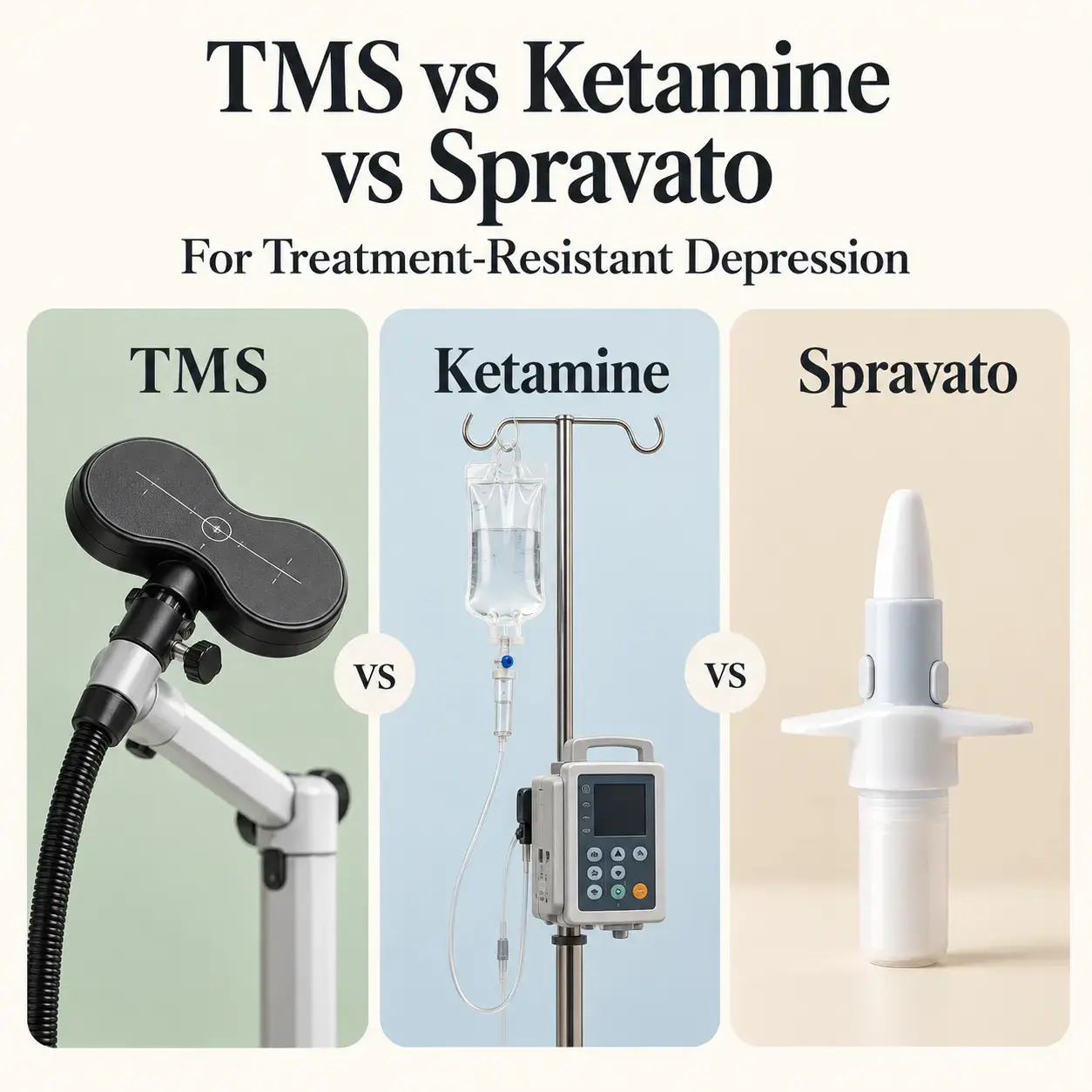
f you are comparing TMS, ketamine, and Spravato for depression, you have probably reached the point where standard antidepressants have not done enough. All three are evidence-based options for treatment-resistant depression, and beyond that they have little in common. TMS is a course of magnetic stimulation delivered while you sit awake in a chair. Ketamine is an anesthetic given by IV, used off-label for depression. Spravato is a nasal spray made from esketamine, one of the two mirror-image forms that make up ketamine, with its own FDA approval and its own rulebook.
None of the three is universally better. They differ in mechanism, speed, setting, and monitoring, and the right one depends on your clinical history and how you respond. Treatment-resistant depression generally means depression that has not adequately improved after at least two antidepressants taken at a proper dose for long enough, and that is the group where all three are most often used.
What Is TMS?
Transcranial magnetic stimulation uses a coil placed against the scalp to deliver focused magnetic pulses to the left dorsolateral prefrontal cortex, a region involved in mood regulation. The FDA first cleared TMS for major depressive disorder in 2008, according to the National Institute of Mental Health. It is delivered in an office, with no anesthesia and no medication.
Our standard TMS course runs 20 to 30 daily sessions over four to six weeks, each 30 to 40 minutes long. You stay awake throughout and drive yourself home afterward. In real-world outcome data from 42 U.S. practices, more than half of patients with medication-resistant depression responded to a standard course, and more than a third reached remission.
What Is Ketamine Therapy?
Ketamine has been an FDA-approved anesthetic since 1970. Its use for depression is off-label: prescribed for a purpose the FDA has not formally approved, which is legal and common in medicine but leaves the safeguards less standardized. It is usually given as an IV infusion in a monitored clinic, as a series of sessions over a few weeks.
Ketamine blocks the NMDA receptor, a glutamate receptor, rather than acting on serotonin like standard antidepressants, and that difference is thought to explain its speed. In a landmark 2006 trial, 18 people with treatment-resistant depression received a single infusion of 0.5 mg/kg, and their symptoms improved significantly within 110 minutes. By the next day, 71% had responded and 29% were in remission. One week later, 35% still met the response threshold. Rapid, real, and often short-lived.
The catch is in the monitoring. Ketamine causes dissociation, a sense of detachment from your body or surroundings, plus sedation and blood pressure rises during and after the infusion, so you are observed until those effects pass and cannot drive that day. In a 2017 consensus statement in JAMA Psychiatry, an American Psychiatric Association task force found the evidence for rapid antidepressant effects convincing but the studies small, the longer-term efficacy data lacking, and the safety data on repeated dosing limited.
What Is Spravato (Esketamine)?
Ketamine is a mixture of two mirror-image molecules. Spravato is esketamine, one of those two, delivered as a nasal spray. Unlike IV ketamine, it has FDA approval for depression. The original approval came in March 2019 for treatment-resistant depression alongside an oral antidepressant, a second indication followed for adults with major depressive disorder and acute suicidal thoughts or behavior, and in January 2025 the FDA approved Spravato as a standalone monotherapy for treatment-resistant depression, with no oral antidepressant required, per the current prescribing information.
That approval comes with a rulebook. Spravato can only be given at a setting certified under a Risk Evaluation and Mitigation Strategy (REMS) program: you take the spray under supervision, you are monitored for at least two hours before an assessment clears you to leave, and you cannot drive until the next day after a restful sleep. Its label carries a boxed warning for sedation, dissociation, respiratory depression, abuse and misuse, and suicidal thoughts and behaviors in younger patients.
So is Spravato the same as ketamine? Related, not identical: same molecular family, same receptor, similar rapid onset and dissociative effects, but a different route, a formal FDA indication, and mandatory monitoring rules that off-label ketamine does not carry. For most people comparing TMS vs Spravato, those rules and insurance coverage are the practical differences that matter.
TMS vs Ketamine vs Spravato: Side-by-Side Comparison
Onset and Duration of Effect
Speed is the clearest dividing line. TMS builds gradually, and many people do not notice a clear change until the second or third week or later. Ketamine and Spravato can shift symptoms within hours to days.
Speed and staying power are different things. Ketamine's effect after a single infusion often fades within a week or two, which is why it is given as a series with maintenance dosing. Spravato starts at twice a week and tapers, with the need for continued treatment reassessed along the way. Research on durability is still developing for all three, and none should be described as permanent.
Side Effects and Safety Considerations
TMS side effects are local and short-lived: scalp discomfort where the coil sits, headache, and sometimes brief lightheadedness or facial muscle twitching during the pulses. These usually settle within the first week, and because nothing enters the bloodstream there is no weight gain, sexual dysfunction, or sedation. Seizure is the one serious risk, exceedingly rare, and TMS is not used in people with a seizure history, metal in the head, or implanted electronic devices.
Ketamine and Spravato share a different profile. The most common reactions to Spravato in trials were dissociation, dizziness, nausea, sedation, vertigo, numbness, anxiety, lethargy, increased blood pressure, vomiting, feeling drunk, and headache. Those effects peak in the hours after dosing, which is what the monitoring window is for, and both drugs carry a potential for misuse that shapes who is a candidate. Each option has its own screening, and a contraindication to one does not rule out the others.
Cost and Insurance
For TMS, most commercial insurers cover treatment for major depressive disorder once eligibility criteria are met, typically a confirmed diagnosis and documented antidepressant trials without adequate relief. Prior authorization is standard. For TMS we take all commercial insurance plans, cash pay is available, and authorization is something our intake team manages for you.
Spravato is more commonly covered than off-label ketamine because it has an FDA indication insurers can write criteria around, though prior authorization and documentation of failed antidepressant trials are typically required. Ketamine infusion coverage varies widely, and many clinics are self-pay. Published cost estimates vary so much by dose, frequency, and insurance status that a single dollar figure would mislead; ask each provider and your insurer directly.
Can These Treatments Be Combined?
Sometimes, and the research is early. A 2024 systematic review found six published studies on combining TMS with ketamine, mostly case reports plus one retrospective review and one small pilot, and reported substantial and sustained improvement with generally mild side effects. The authors also said the designs were too varied and the samples too small for firm conclusions, and called for randomized trials.
In practice, TMS and Spravato are sometimes used one after the other. Combining any of these is a clinical judgment a psychiatrist makes from your history, not a general recommendation, and the more common pattern is to use one, assess the response, then decide.
Choosing Between Them: What Influences the Decision
A psychiatrist weighing these options usually works through a short list:
- Treatment history. Which antidepressants, at what doses, for how long, and whether psychotherapy has been tried.
- How urgently relief is needed. When symptoms are severe or suicidal thoughts are present, a faster-acting option may take priority, alongside care for suicidal thoughts.
- Tolerance for the experience. Dissociation and a two-hour monitored window, versus a daily half-hour appointment for several weeks with no drug effects.
- Practical constraints. Whether you can get to daily sessions, whether someone can drive you home after Spravato or ketamine, and what your insurance will authorize.
- Health factors. Seizure history, metal implants, blood pressure, and any history of substance misuse each rule options in or out.
- What else is in place. Any of the three works better inside ongoing psychiatric care and therapy than as a standalone fix.
Making the Decision With an Integrated Care Team
TMS, ketamine, and Spravato are tools, and tools do their best work inside a plan: a psychiatrist who knows your history, a therapist working alongside the biological treatment, and a team that notices when the plan needs to change.
That is how we work. At Amae, our one-team care model combines psychiatry, therapy, primary care, and peer support, and TMS and Spravato are available through our Los Angeles and Bay Area clinics as part of that care. If you have been through the antidepressant cycle and want a clear, unhurried look at what comes next, talk with an Amae psychiatrist about your options. If you are in crisis or thinking about suicide, call or text 988 now.
Frequently Asked Questions
What is the difference between TMS and ketamine for depression?
TMS stimulates the brain with magnetic pulses over a course of daily outpatient sessions, with no drug, no sedation, and no monitoring afterward. Ketamine is a medication that acts on NMDA receptors, given by infusion or, as esketamine, by nasal spray, with monitored sedation and dissociation and often faster but shorter-lived effects.
Is Spravato the same as ketamine?
Related but not identical. Spravato is esketamine, the S-enantiomer of the ketamine molecule, delivered as an FDA-approved nasal spray under a required monitoring program. Ketamine infusions use the full ketamine compound and are prescribed off-label for depression, without an FDA indication for that use.
Is Spravato only approved with an antidepressant?
Not anymore. The original 2019 approval was for use alongside an oral antidepressant, and in January 2025 the FDA also approved Spravato as a standalone monotherapy for adults with treatment-resistant depression. Whether it is used alone or with an antidepressant is a decision your psychiatrist makes based on your situation.
Which works faster, TMS or Spravato?
Spravato. Esketamine and ketamine can produce symptom change within hours to days, while TMS builds gradually across a four-to-six-week course. Faster onset does not mean more durable improvement, and both durability and side effects belong in the comparison.
Can TMS and Spravato be used together?
Sometimes, as a clinical decision made with a psychiatrist based on your individual history. Both can be part of a broader treatment-resistant depression plan alongside medication and therapy, and the evidence on combining them is still early.
Is ketamine or Spravato covered by insurance?
Spravato is more commonly covered, because it has an FDA indication insurers can build criteria around, though prior authorization and proof of failed antidepressant trials are usually required. Coverage for off-label ketamine infusions varies widely and is often self-pay. Confirm with the provider and your insurer before starting.
Citations
- National Institute of Mental Health. Brain Stimulation Therapies. https://www.nimh.nih.gov/health/topics/brain-stimulation-therapies/brain-stimulation-therapies (Tier 2)
- Carpenter LL, Janicak PG, Aaronson ST, et al. Transcranial magnetic stimulation (TMS) for major depression: a multisite, naturalistic, observational study of acute treatment outcomes in clinical practice. Depression and Anxiety. 2012. https://pubmed.ncbi.nlm.nih.gov/22689344/ (Tier 1)
- Zarate CA, Singh JB, Carlson PJ, et al. A randomized trial of an N-methyl-D-aspartate antagonist in treatment-resistant major depression. Archives of General Psychiatry. 2006. https://pubmed.ncbi.nlm.nih.gov/16894061/ (Tier 1)
- Sanacora G, Frye MA, McDonald W, et al. A consensus statement on the use of ketamine in the treatment of mood disorders. JAMA Psychiatry. 2017. https://pubmed.ncbi.nlm.nih.gov/28249076/ (Tier 1)
- U.S. Food and Drug Administration. Drugs@FDA: SPRAVATO (esketamine), NDA 211243, approval history. https://www.accessdata.fda.gov/scripts/cder/daf/index.cfm?event=overview.process&ApplNo=211243 (Tier 2)
- U.S. Food and Drug Administration. SPRAVATO (esketamine) nasal spray prescribing information, revised January 2025. https://www.accessdata.fda.gov/drugsatfda_docs/label/2025/211243s016lbl.pdf (Tier 2)
- Arubuolawe OO, Folorunsho IL, Busari AK, et al. Combination of transcranial magnetic stimulation and ketamine in treatment-resistant depression: a systematic review. Cureus. 2024. https://pubmed.ncbi.nlm.nih.gov/39156335/ (Tier 1, small-study review)
- 988 Suicide and Crisis Lifeline. https://988lifeline.org (Tier 2)