
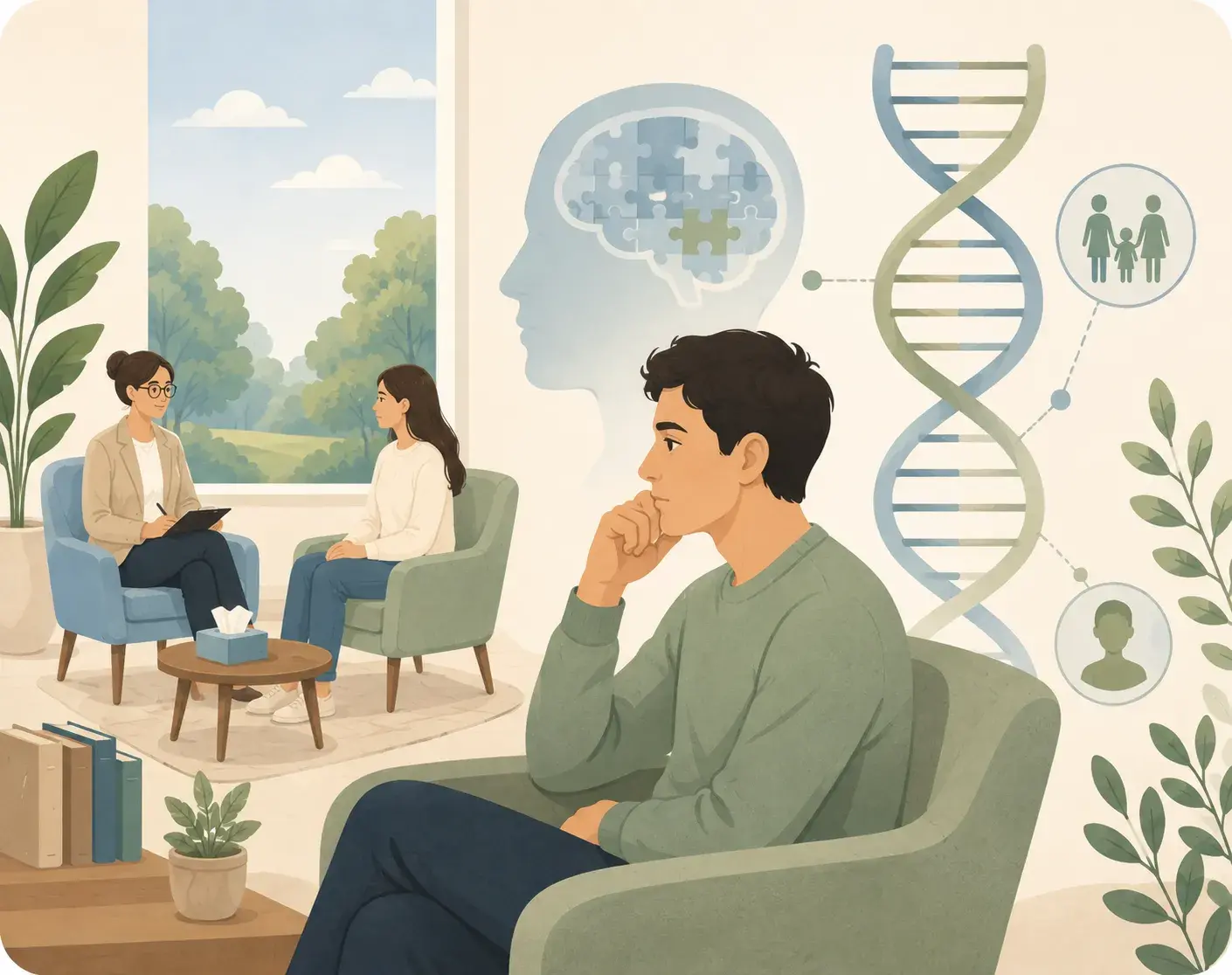
Is schizophrenia genetic? Yes, genetics plays a major role. Research attributes up to about 80% of the risk of developing schizophrenia to genetic factors. But that number comes with an important qualification: no single gene causes schizophrenia, and genes are not the whole story. Having a relative with the condition raises a person's risk, yet most people with an affected relative never develop it, and most people who do develop schizophrenia have no family history of it at all. Genetic risk is real, but it is not destiny. This article explains what the genetics actually show, what else contributes, the types and early signs, and what it means for families.
Is Schizophrenia Hereditary? What the Genetics Show
Schizophrenia can run in the family, and decades of twin, family, and adoption studies have measured how strongly. Twin studies are especially informative. Because identical twins share nearly all their genes while fraternal twins share about half, comparing how often each type of twin shares a diagnosis lets researchers estimate the genetic contribution. Those studies put the heritability of schizophrenia at roughly 79% to 81%, meaning genetic differences account for a large share of why some people develop it and others do not (Sullivan et al., Archives of General Psychiatry, 2003; Hilker et al., Biological Psychiatry, 2018).
It helps to be clear about what heritability does and does not mean. It describes how much of the variation in risk across a population is linked to genetic differences; it does not mean an individual has an 80% chance of developing the condition, and it does not mean the outcome is fixed at birth. Even in identical twins, when one twin has schizophrenia the other develops it only about half the time, which tells us plainly that genes load the dice but do not determine the roll.
So is schizophrenia genetically inherited in a simple way like eye color? No. It is polygenic, which means many genes are involved rather than one. Thousands of common gene variants each add a tiny amount of risk, and a smaller number of rarer variants carry larger effects. Many of these genes influence how brain cells form connections, called synapses, and how chemical messengers between neurons work. There is no single "schizophrenia gene," and because the genetics are spread across so many variants, schizophrenia does not follow a clear-cut pattern of inheritance the way some conditions do (MedlinePlus, Schizophrenia).
How Family History Affects Risk
Family history is the strongest single predictor of risk. The figures below come from classic family and twin studies, and they are best read as approximate lifetime risks for a population, not as a fixed forecast for any one person.
Family history
Approximate lifetime risk
Put another way, having one first-degree relative (a parent or sibling) with schizophrenia raises an individual's risk roughly eight-fold, and having two first-degree relatives raises it about eleven-fold compared with someone with no family history.
A first-degree relative means a parent, sibling, or child (the family members who share about half of your genes). Second-degree relatives, such as grandparents, aunts, and uncles, share less, which is why the risk from a grandparent with schizophrenia is much closer to the general-population figure.
Those numbers can look frightening, so it is essential to read them alongside two facts that are just as true. First, about four out of five people who develop schizophrenia have no affected first-degree relative. Most cases are what researchers call sporadic, arising without a clear family history. Second, even at the highest end of the table, the majority outcome is not developing the condition. With one affected parent, roughly 85 to 90% of children do not develop schizophrenia, and with both parents affected, the majority still do not. Elevated risk is real. Inevitability is not. If you are reading this table with a specific family member in mind, the most useful takeaway is not a percentage but a plan: know the early signs, and know that early care helps.
What Causes Schizophrenia? Beyond Genetics
If you are asking what causes schizophrenia, the honest answer is that genes and environment work together, shaping brain development over time. No single factor acts alone, and there is no one "cause" that applies to everyone. Two people can arrive at the same diagnosis by very different routes, one carrying more genetic risk, another shaped more by environmental factors. This is part of why schizophrenia looks somewhat different from person to person. Alongside genetic risk, researchers have identified several contributors that may increase the likelihood of developing schizophrenia:
- Prenatal and birth factors: complications during pregnancy or birth, maternal infections, or malnutrition before birth.
- Brain chemistry: differences in neurotransmitter systems, particularly dopamine and glutamate, that affect how brain signals are regulated.
- Brain structure and development: subtle differences in brain structure and in how regions connect to one another.
- Substance use: frequent cannabis use in adolescence, especially in people who already carry higher genetic risk.
- Early-life stress or trauma: severe childhood adversity.
- Immune and inflammatory factors: some research links immune activation during key developmental windows to later risk.
Each of these is associated with increased risk rather than a guaranteed cause. Most people exposed to any one of them never develop schizophrenia. The current understanding is what researchers call a neurodevelopmental model: genetic vulnerability and environmental factors interact over years, subtly shaping how the brain develops long before any symptoms appear. This is why schizophrenia typically emerges in late adolescence or early adulthood, a period of major brain maturation, rather than in childhood. It is the combination of influences across development, not any single element, that determines whether the condition emerges. That also means risk is not static: some environmental contributors, like heavy adolescent cannabis use, are ones a person or family can act on.
Types of Schizophrenia
The way clinicians classify schizophrenia has changed. Before 2013, the condition was divided into five subtypes. The DSM-5, and the current DSM-5-TR, folded those subtypes into a single diagnosis of schizophrenia. The reason for the change was that the old subtypes were not stable over time. A person could shift from one to another, and they did not reliably predict treatment response or outcome. In their place, clinicians now use specifiers, notes that describe features like the course of the illness or the presence of catatonia, to capture a person's particular pattern. The older subtype names still appear in some writing, so they are worth knowing:
- Paranoid: prominent delusions and hallucinations.
- Disorganized (hebephrenic): disorganized thinking and speech, and flattened emotional expression.
- Catatonic: movement disturbances, including immobility or mutism.
- Undifferentiated: features of more than one type.
- Residual: reduced symptoms following a previous episode.
Schizophrenia also sits within a broader schizophrenia spectrum that includes related conditions such as schizoaffective disorder, which combines features of schizophrenia and a mood disorder, and schizophreniform disorder, which involves similar symptoms over a shorter period. A clinician distinguishes between these based on the specific pattern and duration of symptoms.
Early Signs of Schizophrenia
The early signs of schizophrenia usually appear in late adolescence or early adulthood, often slightly later in women than in men. Before a first episode, changes can be gradual and easy to miss, which is exactly why families search for them. Common early signs include:
- Social withdrawal and loss of interest in friends or activities
- A decline in functioning at school or work
- Difficulty concentrating or increasingly disorganized thinking
- Unusual or suspicious thoughts, or a sense that something has changed
- Reduced emotional expression or motivation
- Changes in sleep or personal hygiene
Clinicians sometimes call this gradual early phase the prodrome, a period of subtle changes that can precede a first episode by months or even years. These signs are not proof of schizophrenia; many have other explanations, from depression to ordinary adolescent change, and most people who experience them will not develop schizophrenia. But when several appear together and persist, they are a reason to seek an evaluation rather than to wait and see.
A first episode of psychosis, which can include hallucinations, delusions, or disorganized speech, is a particularly important moment. Research consistently shows that the sooner coordinated care begins after psychosis emerges, the better the long-term outcomes tend to be (NIMH, Schizophrenia). Seeking an evaluation early is not an overreaction; it is one of the few things clearly within a family's control that improves the odds.
What This Means for Families
If schizophrenia is in your family, the worry behind the question is usually personal: does this mean it will happen to me, or to my child? The evidence offers a genuinely reassuring answer. A family history raises risk, but it does not make the condition inevitable, and genetic risk is not the same as genetic destiny.
A few things are worth holding onto. There is no routine genetic test that can predict or diagnose schizophrenia, because the condition involves thousands of genes interacting with the environment; diagnosis is clinical, based on symptoms and history. Direct-to-consumer genetic tests that claim to estimate psychiatric risk cannot tell an individual whether they will develop schizophrenia, and a worrying result from one is not a diagnosis.
What families can do is practical rather than passive: learn the early signs, seek an evaluation promptly if concerns come up rather than waiting, and know that effective treatment exists. Modern care combines medication, therapy, and support to help people manage symptoms and build stable, meaningful lives, and outcomes are best when treatment starts early and stays coordinated. For someone carrying a family history, that is the real source of agency: not the genes they inherited, which no one chooses, but the speed and quality of the care they can reach if it is ever needed.
At Amae Health, schizophrenia is one of the conditions our integrated teams are built to treat. If you are looking for information, our guide to the best treatment for schizophrenia and our care for psychosis and first-episode psychosis explain what evidence-based treatment looks like. You can also explore our full range of treatments or read our resources for patients and families. To ask about an evaluation, reach out to our team.
Frequently Asked Questions
Is schizophrenia genetic or environmental?
Both. Genetics accounts for up to about 80% of risk, but environmental factors such as prenatal complications, early trauma, and heavy cannabis use interact with genes to shape whether the condition develops. Neither genes nor environment alone fully explains it.
If a parent has schizophrenia, will their child get it?
Not necessarily. With one parent affected, a child's lifetime risk is roughly 10 to 15%, which means most children of a parent with schizophrenia do not develop it. The risk is higher than average, but it is far from certain.
Can you have schizophrenia with no family history?
Yes. About four out of five people with schizophrenia have no affected first-degree relative. Genetic risk can come from many small variants that are common in the population, and environmental factors also contribute, so the condition frequently appears without a clear family history.
Is there a genetic test for schizophrenia?
No. There is no routine test that can predict or diagnose schizophrenia. Because the condition involves thousands of genes plus environmental influences, no single test can capture it. Diagnosis is made clinically, based on symptoms and history.
At what age does schizophrenia usually appear?
Typically in late adolescence to early adulthood, and often slightly later in women. Early, subtle signs can appear gradually in the months or years before a first episode of psychosis.
Can schizophrenia be prevented if it runs in my family?
It cannot be reliably prevented, but risk can be lowered and outcomes improved. Avoiding heavy cannabis use, managing stress, and seeking evaluation early if warning signs appear all help, and early intervention is linked to better outcomes. If you or a loved one is struggling, support is available: call or text the 988 Suicide and Crisis Lifeline at 988, anytime.
Citations
- Sullivan PF, Kendler KS, Neale MC. "Schizophrenia as a Complex Trait: Evidence From a Meta-analysis of Twin Studies." Archives of General Psychiatry, 2003. PubMed 14662550. Tier 1 (peer-reviewed meta-analysis).
- Hilker R, Helenius D, Fagerlund B, et al. "Heritability of Schizophrenia and Schizophrenia Spectrum Based on the Nationwide Danish Twin Register." Biological Psychiatry, 2018. sciencedirect.com. Tier 1 (peer-reviewed).
- MedlinePlus (National Institutes of Health), "Schizophrenia." medlineplus.gov/genetics/condition/schizophrenia. Tier 2 (U.S. government).
- National Institute of Mental Health, "Schizophrenia." nimh.nih.gov/health/topics/schizophrenia. Tier 2 (U.S. government).