
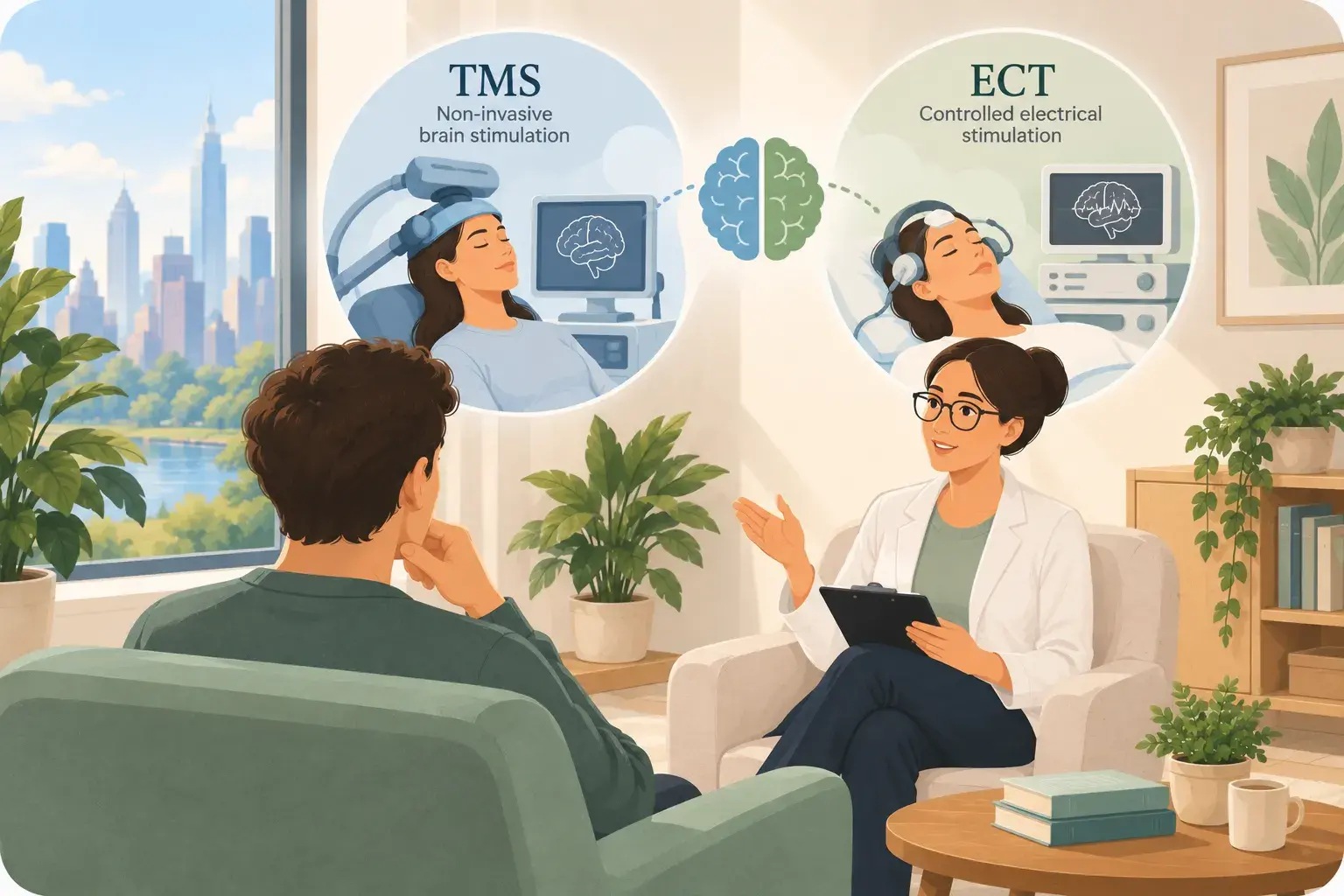
TMS is not shock therapy. That is the first thing to settle in any TMS vs ECT comparison, because that phrase, and all the baggage that comes with it, refers to electroconvulsive therapy (ECT), not transcranial magnetic stimulation. TMS uses magnetic pulses, involves no anesthesia and no seizure, and you drive yourself home afterward. Both are evidence-based brain stimulation treatments for depression, and both work. They differ substantially in how they work, what the treatment is like to go through, and who they are typically used for. Knowing the difference between TMS and ECT is what lets you and your psychiatrist match the treatment to the situation.
What Is TMS?
Transcranial magnetic stimulation delivers focused magnetic pulses through a coil resting on the scalp to a specific region of the brain, usually the left dorsolateral prefrontal cortex, which is involved in mood regulation. The stimulation is targeted to that one site rather than generalized across the brain, and because it stimulates a small area without inducing a seizure, the procedure needs no anesthesia and takes place in an ordinary clinic or office, as the National Institute of Mental Health describes. FDA clearance came in 2008 for major depressive disorder, with obsessive-compulsive disorder added in 2018.
At our clinics, a standard course of TMS therapy is 20 to 30 sessions, one per weekday, 30 to 40 minutes each, over about four to six weeks, and you sit awake in a chair for every one of them. No seizure is induced, nothing enters your bloodstream, and when the session ends you can drive yourself home and return to your day.
What Is ECT?
Electroconvulsive therapy is a controlled medical procedure performed under general anesthesia. You are given a short-acting anesthetic and an intravenous muscle relaxant to prevent movement, and electrodes on the scalp deliver a brief electrical current that produces seizure activity in the brain lasting under a minute. You wake within minutes, recover over the following hour or so, and need someone to take you home. A typical course is three sessions a week until symptoms improve, usually within 6 to 12 treatments.
ECT is one of the oldest treatments in psychiatry and one of the most effective for severe depression. The FDA's clearance covers catatonia and severe depressive episodes in people age 13 and older with major depression or bipolar disorder who have not responded to other treatments or need a rapid response, and it is also used for mania and for certain presentations of schizophrenia and schizoaffective disorder. It is most often reserved for situations where fast, powerful relief matters: acute suicidality, depression with psychotic features, or catatonia.
The stigma around ECT comes from portrayals that are decades out of date, from an era before anesthesia and muscle relaxants were used. Modern ECT is delivered in a monitored setting by a full medical team, and its main drawback is not what those old images suggest. It is the effect on memory, covered below.
TMS vs ECT: Side-by-Side Comparison
Effectiveness: What the Research Shows
Both treatments work. In head-to-head trials of electroconvulsive therapy vs TMS, ECT comes out ahead. A 2014 systematic review and meta-analysis in Depression Research and Treatment pooled nine randomized clinical trials comparing the two, with 384 participants in total. Both groups improved significantly. On the Hamilton Depression Rating Scale, the standard clinician-rated measure, scores fell by an average of 15.4 points with ECT and 9.3 points with TMS, a statistically significant difference (P = 0.011). The author concluded that ECT produced larger reductions in depressive symptoms, while the results also supported the therapeutic validity of TMS for people with treatment-resistant depression.
A few things keep that finding in proportion. The trials were conducted between 2000 and 2011, largely with early TMS protocols. And "more effective" is not the same as "the right choice." Real-world TMS outcomes come from a different population. In naturalistic data from 42 U.S. clinics, 58% of outpatients with medication-resistant depression responded to a standard course and 37% reached remission. For someone whose depression has resisted medication but who is stable enough for outpatient care, that is the relevant number.
In the head-to-head studies that exist, ECT delivers stronger short-term symptom reduction. TMS delivers a meaningful effect without anesthesia, without a hospital, and without the recovery and memory considerations described next.
Side Effects and Memory Concerns
Memory is the question people bring to this comparison more than any other, and it deserves a direct answer.
ECT is associated with memory effects, particularly for events around the time of treatment. NIMH describes memory loss close to the treatment period that is sometimes more severe but usually improves over the days and weeks after the course ends, alongside headaches, upset stomach, muscle aches, and short-lived confusion. The largest analysis of the question, a 2010 meta-analysis in Biological Psychiatry covering 84 studies and 2,981 patients, found that measurable cognitive effects were mainly limited to the first three days after treatment. By 4 to 15 days, nearly all measures had recovered, and after 15 days processing speed, working memory, new learning, and some aspects of executive function had improved beyond where they were before treatment, most likely because the depression itself had lifted. Some people do report longer-lasting gaps in personal memories from the months around treatment, and that possibility belongs in the conversation before ECT.
TMS carries no known negative effect on memory or thinking, and it requires no anesthesia. Its side effects are local: discomfort where the coil sits, tingling or twitching of scalp or facial muscles during the pulses, mild headache, and occasional brief lightheadedness. Those usually fade within the first week. Seizure is the one serious risk, and it is exceedingly rare. Screening for seizure history, metal in the head, and implanted devices is what keeps it that way.
What to Expect: The Treatment Experience
The daily reality of the two treatments could not be more different.
A TMS session is a 30-to-40-minute appointment. You sit in a chair, awake, while the coil delivers pulses that feel like tapping on the scalp. When it ends, you stand up, get in your car, and go on with your day, then repeat tomorrow. There is no downtime and no preparation beyond an initial screening visit.
An ECT session is a medical procedure. You fast beforehand, an IV is placed, and you are under anesthesia for a few minutes while the treatment is delivered in a hospital or specialized clinic with an anesthesia provider and a psychiatrist present. You wake up groggy, spend time in recovery, and need someone to take you home. Over several sessions a week for several weeks, that is a real commitment from you and whoever supports you, and ECT is sometimes delivered during an inpatient stay rather than as an outpatient.
Who Is Each Treatment Typically Recommended For?
These are different tools for different clinical pictures, not simply a better and a worse option.
ECT is typically recommended when depression is severe, acute, or urgent, and the speed of response matters: someone at high risk of suicide, someone with psychotic depression, someone with catatonia, or someone who has not responded to multiple treatments. The trade-off of anesthesia and memory effects is accepted because the alternative is worse, and for anyone in that situation care for suicidal thoughts comes first.
TMS is typically recommended for moderate or treatment-resistant depression in someone who is stable enough for outpatient care and can attend daily sessions, when there is no need for the fastest possible response. It is often the next step after antidepressants have failed and before ECT would be considered. For that person, a treatment without anesthesia, without memory effects, and without disruption to work or family life has real value, even if its average effect size is smaller.
Talking to a Psychiatrist About Your Options
Choosing between TMS and ECT is a clinical decision, made with a psychiatrist, that turns on three things: how severe your depression is, how urgently it needs to change, and what you have already tried. It is not a decision to make from a comparison table alone, including this one.
At Amae, we offer TMS at our Los Angeles, Los Altos, and San Mateo clinics as part of our integrated outpatient clinics, where psychiatry, therapy, primary care, and peer support come from one team. We do not offer ECT. If our psychiatrists conclude that ECT is the better clinical fit for you, they will say so and help coordinate a referral, because the goal is the right treatment, not the treatment we happen to provide. If you are trying to work out where you stand, talk with an Amae psychiatrist. And if you are having thoughts of suicide right now, call or text 988, the Suicide and Crisis Lifeline.
Frequently Asked Questions
Is TMS the same as ECT?
No, and it is not "shock therapy" either. That phrase refers to ECT. TMS uses magnetic pulses targeted to one region of the brain, with no anesthesia and no seizure, and you stay awake and drive yourself home. ECT uses electrical stimulation to produce a brief, controlled seizure under general anesthesia in a monitored medical setting.
Does TMS cause memory loss like ECT can?
No. TMS has no known negative effect on memory or thinking; its side effects are scalp discomfort and headache, both short-lived and usually gone within a week. ECT can cause memory loss around the time of treatment that typically improves over the weeks after the course ends.
Which is more effective, TMS or ECT?
In head-to-head research, ECT produces larger short-term symptom reductions. A 2014 meta-analysis of nine randomized trials found average Hamilton scale drops of 15.4 points with ECT versus 9.3 with TMS, with both treatments producing significant improvement. TMS remains a well-supported outpatient option without anesthesia or recovery time, so "more effective" is not the same as "right for your situation."
Is ECT still used today?
Yes. ECT remains a well-established, evidence-based treatment, typically used for severe, urgent, psychotic, or catatonic depression and for depression that has not responded to other treatments. The stigma around it comes from decades-old portrayals that do not resemble modern practice.
Can you drive yourself home after TMS or ECT?
After TMS, yes. There is no anesthesia or sedation, so people typically drive themselves home and return to their day immediately. After ECT, no. General anesthesia means you need a support person to take you home and some recovery time before normal activities.
Does Amae Health offer ECT?
No. We offer TMS at our Los Angeles, Los Altos, and San Mateo clinics as part of integrated psychiatric care. We do not offer ECT, and if a psychiatrist concludes that ECT is the better fit for your situation, we help coordinate a referral to a provider who does.
Citations
- Micallef-Trigona B. Comparing the effects of repetitive transcranial magnetic stimulation and electroconvulsive therapy in the treatment of depression: a systematic review and meta-analysis. Depression Research and Treatment. 2014. https://pubmed.ncbi.nlm.nih.gov/25143831/ (Tier 1)
- National Institute of Mental Health. Brain Stimulation Therapies. https://www.nimh.nih.gov/health/topics/brain-stimulation-therapies/brain-stimulation-therapies (Tier 2)
- Semkovska M, McLoughlin DM. Objective cognitive performance associated with electroconvulsive therapy for depression: a systematic review and meta-analysis. Biological Psychiatry. 2010. https://pubmed.ncbi.nlm.nih.gov/20673880/ (Tier 1)
- Carpenter LL, Janicak PG, Aaronson ST, et al. Transcranial magnetic stimulation (TMS) for major depression: a multisite, naturalistic, observational study of acute treatment outcomes in clinical practice. Depression and Anxiety. 2012. https://pubmed.ncbi.nlm.nih.gov/22689344/ (Tier 1)
- 988 Suicide and Crisis Lifeline. https://988lifeline.org (Tier 2)